Proxmox Is No Longer a Niche Product: Our Impressions from proxtalks 2026
Anyone walking into Westhafen Pier 1 in Frankfurt on 20 October quickly noticed: this is not a hobbyist experiment. proxtalks, hosted by Thomas-Krenn.AG, was fully booked. For an entire day, everything revolved around Proxmox VE, the open-source virtualization platform, and the question of how companies use it in production.
Our managing director Moataz Elmasry and our DevOps engineer Julius Schlüter attended on behalf of CONTENSI. The programme featured technical talks, practical experience reports and plenty of time for conversations with vendors, developers and other IT professionals.
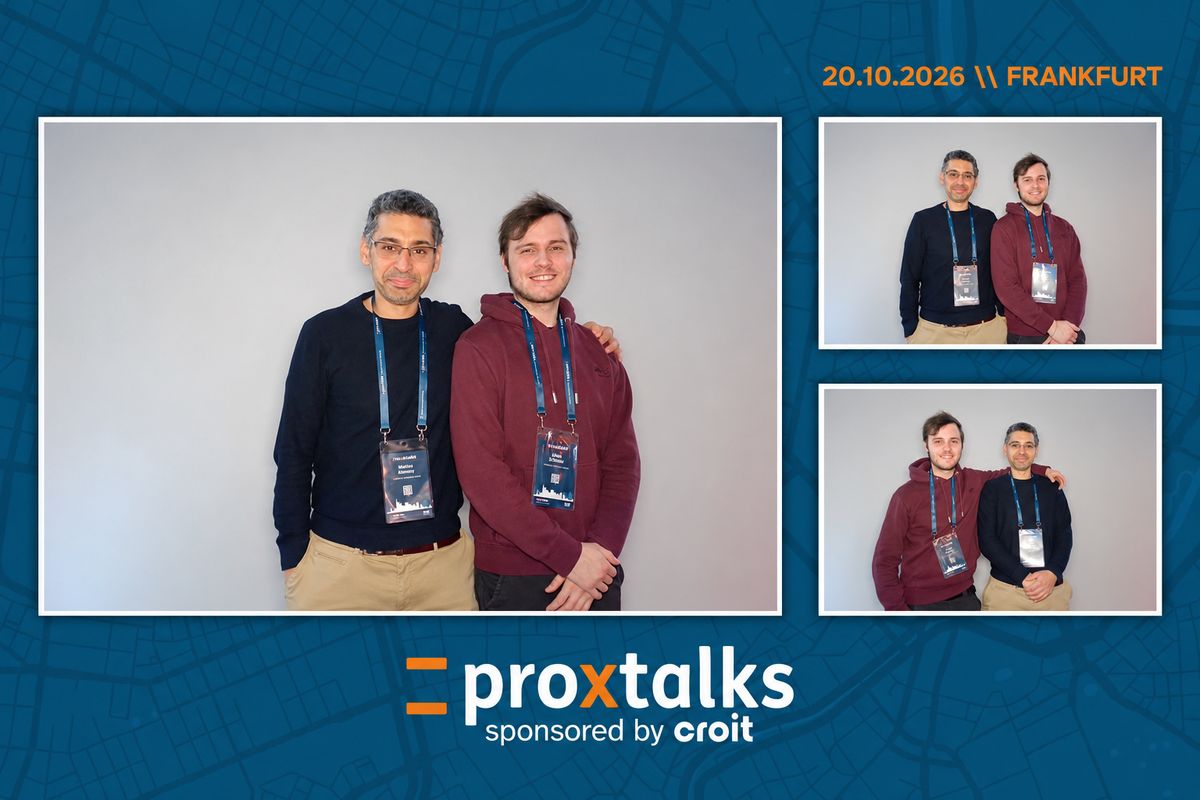
Moataz Elmasry (left) and Julius Schlüter at proxtalks 2026 in Frankfurt
Topics of the day
The talks showed how broad the Proxmox ecosystem has become. For companies evaluating a switch, these topics were particularly interesting:
- High availability and storage. Several talks focused on how to store data in a fault-tolerant way. At the centre were Ceph, which is integrated directly into Proxmox, and LINSTOR as another solution for highly available storage. Another topic was how to use storage capacity efficiently without sacrificing performance.
- Multi-site clusters and disaster recovery. What happens if an entire site goes down? This part covered Ceph environments that mirror data across several sites, an important building block for real resilience.
- Software-defined networking. How networks in Proxmox clusters can be controlled by software was the subject of a hands-on talk, using a small cluster as an example. This is especially relevant for mid-sized environments.
- AI in your own data centre. One talk looked at using GPUs directly in the hypervisor to run AI applications in-house. The data stays on your own premises, a topic we also work on in our Private AI offering.
- Modern workplaces with Kasm. Our new partner Kasm Technologies talked about combining Kasm Workspaces with Proxmox to stream desktops and applications securely to the browser.
- Automation and operations. Further topics included automatic load balancing within the cluster and controlled shutdown during power outages in combination with a UPS. Details like these determine whether day-to-day operations run smoothly.
Voices from the team
For Julius Schlüter, it was his first proxtalks:
“It was my first time at proxtalks, and I found it a pleasant and informative event. There were some exciting talks and experience reports, as well as interesting insights into current and upcoming developments, both at Proxmox itself and at other companies working with Proxmox.”
Besides the talks, the conversations mattered most. proxtalks offered a good opportunity to talk to other providers and to explore possible future partnerships.
“I took away a lot of knowledge about Ceph, Kasm, UPS and of course Proxmox itself. Proxmox no longer seems to be a niche product and has definitely moved into the focus of more and more companies.”
What this means for businesses
proxtalks confirmed what we also hear in conversations with IT decision-makers: more and more companies are looking for cost-effective, flexible and vendor-independent alternatives to traditional virtualization platforms. Proxmox has long been a serious option, including for production environments.
The talks also made one thing clear: the platform alone is not what matters most. Whether a migration succeeds depends on questions such as storage, high availability, networking, backup and well-organised operations. That is exactly why it pays to plan a migration carefully rather than rushing it.
Our conclusion
Open source has arrived in the data centre. Proxmox shows that powerful virtualization, high availability and modern storage concepts do not have to depend on proprietary platforms.
We are taking many ideas from Frankfurt back into our work, and we are already looking forward to the next proxtalks. Thank you to Thomas-Krenn.AG for organising the event and to all speakers for the valuable insights.
Wondering whether Proxmox is right for your organisation? In our Proxmox workshop, we take a joint look at your existing environment. Afterwards, you receive a clear recommendation with a high-level roadmap showing whether and how a migration makes sense for you. Learn more about our Proxmox services
Next step
Questions about this topic?
We’ll help you assess what’s relevant for your environment – no sales pitch.
Book an initial consultation